
https://orcid.org/0009-0000-2960-0681
Bodoland University
Received: 30 June 2026 / Accepted: 2 July 2026 / Published:12 July 2026
Book reviews are internally reviewed.
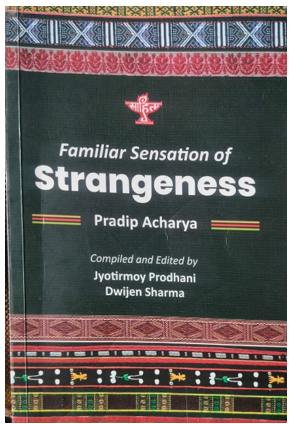
Familiar Sensation of Strangeness: Selected Essays and Speeches on Northeast Literature, Translation and Contemporary Assamese Writings
Pradip Acharya ׀ Edited by Jyotirmoy Prodhani and Dwijen Sharma
Sahitya Akademi (2025) ׀ ISBN: 978-93-6183-428-8
Paperback ׀ 113 pages ׀ Price: Rs. 180.
Familiar Sensation of Strangeness (2025) is a critical anthology of writings and lectures by eminent Assamese scholar and translator Pradip Acharya. The book is both a tribute to and an archive of Acharya’s mostly unpublished and scattered works. It offers Pradip Acharya’s dynamic engagement with translation, literary criticism, comparative literature, and Assamese as well as Northeast Indian literary traditions. Additionally, the book is of critical significance in Acharya’s engagement with Assamese literature, particularly through translation and critical interpretation, which reflects how regional writing can be placed within the global literary and intellectual frameworks. The book has been thematically organised into three sections: On Translation, On Literatures from Northeast, and Contemporary Assamese Writings – preceded by an introduction and a biographical note on Pradip Acharya, and concluded with an Interview. The title itself refers to the process of translation that operates in a dual register, suggesting the process of Freudian “Uncanny” and the Shklovskyan “Defamiliarisation”, and also captures the experience of the translator. According to Acharya, translation is not only a mere act of transferring from one language to another, but an encounter in which both the source and the target culture become unsettled and reinterpreted. He describes the “strangeness” as the realisation of the text after it is translated; the original appears transformed, almost alien, to the native reader.
The first section, On Translation, begins with the essay, “Is Translation a Third Language”, where Acharya examines his own translations of poets like Hiren Bhattacharya and Nabakanta Barua from Assamese into English and examines whether translation can be understood as a third Language. His translation reflects a deep understanding of the local culture and conceptual metaphors such as “love as a flame” or “love as divinity”, transferring these supernal feelings from the Assamese idiom into global English. His translation shows a “familiar” comfort of Assamese folk traditions meeting the “strangeness” of Western literary forms. This is not a dry academic exercise; it is what Prof. Rakhee Kalita Moral describes as making the finest literature of Assam accessible to a global audience through “tactile sensation” and “transference”. The essay begins with a self-reflexive admission of Acharya that translation is not his formal disciplinary specialisation, but his long empirical involvement with translation compels him to examine its theoretical foundations. This self-positioning is important because it sets the tone of the essay. The text doesn’t offer a systematic theory; rather, Acharya approaches translation as a field of doubts, questions, and ongoing inquiry. He argues that modern Translation studies have reached a fragmented state with multiple orientations, including linguistic, hermeneutic, literary, and cultural approaches. By deliberately distancing himself from the traditional model of translation, he shifts his discussion of Translation within literary criticism and cultural studies, suggesting that translation is a humanistic practice. In the essay, Acharya proposes the most provocative idea that translation can also be understood as “a third language”. However, he didn’t claim that translation creates an entirely new linguistic system; rather, he uses the phrase metaphorically to describe the signifying space translation produces when two languages encounter each other. Here, Acharya rejects the reductive binary of Translation: “Faithfulness vs Betrayal”. Instead, he engages with what Homi Bhabha calls “the third space” of communication. When a translator translates a text from the source language to the target language, and it interacts with the socio-cultural context, a third language emerges that belongs fully to neither side. In the next essay, “Poetry is like Local Wine”, he discusses the challenge of rendering Assamese rhythms into the global English structure. In this regard, he metaphorically compared poetry with local wine, it doesn’t travel well; it tends to lose harvest and history if sipped abroad”. He argued that the translation of poetry is not merely an academic exercise but an act of transference – moving meaning from the “empty space between lines which is the culture of that” (p. 17) to resonate with a new audience. So, if a translator wants to make a significant translation even while using an imperial tongue, he/she “know the culture of both the original and target language” (p. 17). He rejects the idea that translation diminishes creative originality. Instead, he argues that translation allows the translator to engage more creatively with the essence of the original work. His references to writers such as Rabindranath Tagore, Shankha Ghosh, Ezra Pound, W. B. Yeats, Navakanta Barua, and Nilmoni Phukan put translation within a greater literary tradition.
The Second section, “On Literatures from the Northeast,” includes Acharya’s lectures and essays, which deal with the anglophone literature from NE and the uniqueness of regional literature. Beginning with Pradip Acharya’s rejection of Indian Literature as a monolithic entity, he discusses the problems of seeing Indian literature as a single unified entity in the opening essay “Indian Literature: A Crisis of Ascription” and claims it’s unstable and misleading. The term itself is a construction of socio-political, historical, and linguistic forces and cannot represent the vast literary traditions across the country. Acharya identifies this instability as a “crisis of ascription,” where the act of placing all literary works under the umbrella term “Indian Literature” becomes problematic due to its competing histories, languages and cultural traditions. In the essay, Acharya also critiques the hegemony of English and Hindi in Indian Literature, which marginalises regional literature, particularly from North East India, whose multilingual and culturally diverse literary tradition doesn’t fit into the unified National narrative. Acharya draws attention to the rich corpus of both written and oral literature produced by different communities like Mizo, Assamese, Nagas and Khasis, and thereby argues for recognisingplurality through a framework of strategic pluralism, where Indian literature is understood not as a singular entity but as a field of multiple, intersecting literary cultures. Continuing the topic in the essay“In the Northeast, We Celebrate Doubt”, Acharya identifies that Northeast Indian literature “celebrates doubt” and combines past and present into a shared narrative. To justify his argument, he gave references to writers like Temsula Ao, Nini Lungalang, and Kynpham Sing Nongkynrih, whose works are rooted in oral traditions, collective memory, and community life, thus resisting singular truth and fixed realities. Northeast Indian literature embraces plurality, ambiguity, and dialogue. Doubt, therefore, becomes not a sign of uncertainty but a part of their aesthetic. In this section, Acharya also argues that regional literature constitutes its own modernity. But it is not a derivative of any Western norms or traditions. Unlike much Western modernist literature, which focuses on the isolated individual, Northeast literature presents individuals within a larger social and cultural network. The past is not treated as a completed and distant event but as something that continues to shape the present through memories, myths, legends, and oral narratives. Acharya, therefore, suggested that the future of NEI literature depends on its “mastered idioms” and diverse realities.
The third section deals with the historiography of Assamese literature, the origin and development of the Assamese short stories beginning with the early modern literature, the history of Assamese fiction, Life writings in Assamese during the colonial period, and also the contemporary trends in Assamese literature. In the essay “Discerning Voices”, he compares the novel with the Assamese short stories and argues that short stories are technically superior and idiomatic. He also discusses the transformation of Assamese poetry between 1975 and 1995, a period which he argued as the golden period of Assamese elegy in the essay “The Renaissance of Elegy”. The essay focuses on how contemporary Assamese poetry is shaped by the experience of violence, social unrest, and historical change. Acharya contends that poets like Cheniram Gogoi, Nilmoni Phukan, Kabin Phukan, Hiren Dutta, and others employed elegy as a mode to respond to these socio-political realities that express collective loss, memory, and uncertainty. In “The Profane Perfection of Man,” the final essay, Acharya offers an insightful reading of Arun Sarma’s dramatic trilogy, comprising Sri Nibaran Bhattacharya, Agnigarh, and Aditir Atmakatha.
The final section of the book, a transcript of an interview titled “Pradip Acharya in Conversation with Prasanta J. Baruah,” provides readers with direct access to Acharya’s voice and his intellectual commitment to the development of the Assamese language and literature. In the interview, Acharya talks about his philosophy of translation and the future of the Assamese language and literature. He also discusses his translation of Syed Abdul Malik’s Suraj Mukhir Swapna, Bhupen Hazarika’s songs, and Hiru Bhattacharyya’s poetry, which reflects his sensitivity to the aesthetic and cultural challenges of translation. In the interview, he also shares his concern for the future of the Assamese language and literary culture in an increasingly Anglophone educational environment. As the concluding section of the anthology, the interview successfully sums up many of the themes explored throughout the volume: translation, literary plurality, regional identity, and cultural transmission.
The book is an important intervention into the fields of Northeast literary studies, Assamese literary criticism, and translation studies. The collection brings together Acharya’s wide-ranging work on translation, regional literary traditions, oral cultures, poetry, fiction, and drama, revealing his dynamic engagement with literature as both a creative and cultural practice. However, the heterogeneous nature of the anthology occasionally results in thematic overlaps, and some essays may benefit from detailed contextualisation for readers not familiar with the history of Assam and the Northeast. Nevertheless, these limitations do little to diminish the overall value of the collection. The volume opens up future possibilities for research on Northeast Indian literatures, translation practices, oral traditions, regional modernities, and the relationship between literature and cultural memory. Therefore, the anthology becomes an indispensable resource for scholars interested in the literary and intellectual traditions of Assam and the wider Northeast.
Acknowledgement: Nil
Conflict of Interest Declaration: The author declared no potential conflicts of interest about the research, authorship, and publication of this article.
Artificial Intelligence usage: Nil
Funding: Not applicable
Bio note
Anirban Roy is a PhD Research Scholar in the Department of English at Bodoland University. His research interests include migration studies, memory studies, and North East Indian writings. He is currently working as an Assistant Professor of English at Bijni College.
Open Access
This article is distributed under the terms of the Attribution-NonCommercial 4.0 International (CC BY-NC 4.0) (https://creativecommons.org/licenses/by/4.0/), which permits any use, reproduction, and distribution of the work without further permission.
For more information, log on to https://thetranscript.in/
© Author